

Café · Chicago · ⭐ 9.3/10 · 2228 reviews · updated: 2026-08-10 15:36:38
Address: 112 N Green St, Chicago, IL 60607, United States
The story of this café starts in Tokyo, not Chicago. Two restaurateurs from a Chicago hospitality group were in Japan, half-seriously fantasizing about opening a coffee bar back home, and went looking for the best one they could find. It belonged to Hiroshi Sawada — a free-pour latte art world champion — and they asked him to come to Chicago and teach their staff how to run a coffee shop properly. He came, looked at how the group cooked and served, and decided he would rather be a partner than a consultant. Sawada Coffee is the result: his first café outside Japan, tucked into a corner of the Fulton Market district, and still one of the few American coffee bars where the drawing in the milk is the headline act.
Highlights
- The first U.S. café of Hiroshi Sawada, who took the free-pour latte art world title in 2008 and built one of Tokyo’s best-known coffee bars.
- The Military Latte — matcha, espresso, vanilla and cocoa dusted in a camouflage pattern — invented here and copied all over the world since.
- A house blend created for this café alone: Project X, developed in secret with a Chicago roaster to rebuild the taste of Sawada’s Tokyo coffee on Midwestern beans.
- Latte art at competition standard as a matter of routine, not as a special request.
- A room that looks like nothing else in the neighborhood: skate decks on the walls, a punching bag, raw wood benches and a table-tennis table.
- Shared premises with a barbecue smokehouse from the same hospitality group — coffee on one side, smoked meat on the other, one doorway between them.
What’s in the cup
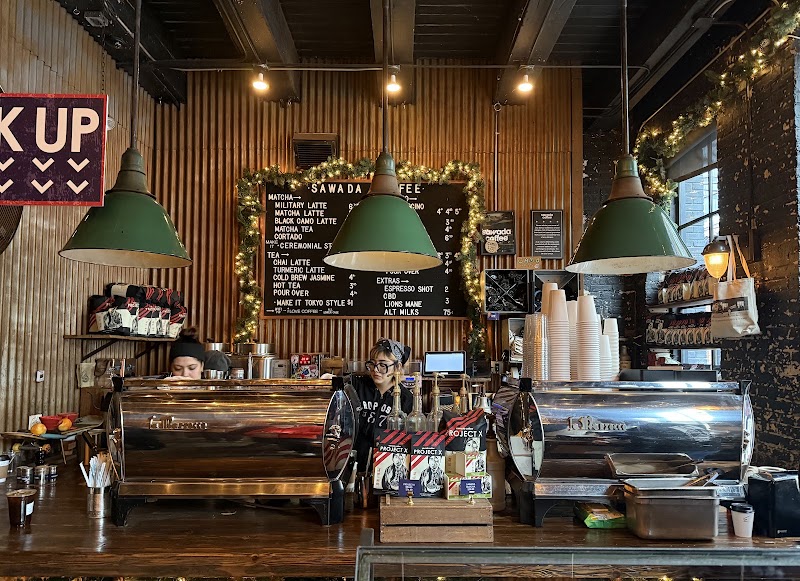
The most interesting decision this café made was not to import its coffee. Sawada already roasted for his Tokyo bar and could easily have shipped it; instead he and his Chicago partners went to Tony Dreyfuss at Metropolis, a roaster on the far north side of the city, with samples of his Japanese roast and a brief: rebuild this, here, with beans we can get fresh. The project ran under a code name, and the code name stuck — the house blend is still called Project X. It is a dark roast with the weight and low acidity of the Japanese kissaten tradition, reading as Italian drinking chocolate and hazelnut, and it is built to work as espresso, as drip and in a French press rather than being tuned to one method. The point is not a rare lot. The point is that a Tokyo palate was translated into a Chicago roastery, and the café pours the result every day.
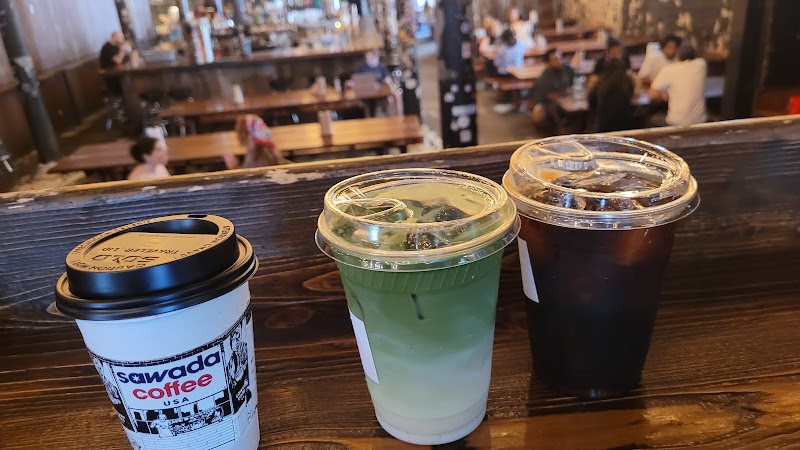
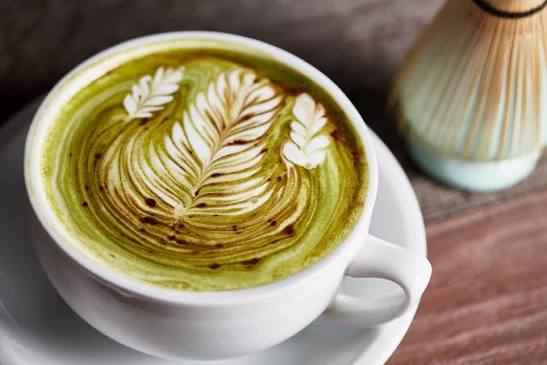
On top of that base sits the drink this place is famous for. The Military Latte layers matcha and vanilla under espresso and finishes with cocoa dusted through a stencil into a camouflage pattern — grassy, bitter, sweet and chocolatey at once, and unlike almost anything else on an American menu. It was invented here, it has been imitated widely, and it is the reason a good share of the line outside is holding phones. There is a matcha program behind it too, serious enough that the roaster sells a Sawada matcha of its own.
And then there is the pouring. A world latte art title is not a marketing line here — it is the house standard, and cappuccinos and lattes arrive with the kind of surface work that most cafés reserve for competitions. Espresso, cortado, cappuccino, latte and drip cover the everyday; oat milk and decaf are available; iced versions run all summer. What you will not find is a rotating single-origin filter bar with a tasting flight. This is a café built on one blend, poured extremely well, day after day — the Japanese idea of coffee as an ordinary drink executed to an extraordinary standard.
Who’s behind it
Hiroshi Sawada won the free-pour latte art world championship in 2008 and turned it into a coffee business in Tokyo that trained a generation of Japanese baristas. His approach is easy to describe and hard to copy: an intentionally short menu, a fixed house taste, and obsessive attention to the two seconds when milk meets espresso. He is not a bean romantic — he talks about coffee as a simple daily drink that, made perfectly, makes the day better. That philosophy is why the Chicago blend was designed to be reproducible rather than rare.
The other half of the partnership is Hogsalt, the Chicago group behind the neighborhood’s best-known burger room and the smokehouse next door. They brought the site, the operational discipline and the doughnut brand; Sawada brought the coffee, the training and the name. It is an unusual pairing — a Japanese barista champion and an American restaurant group — and it explains the café’s odd double character: the service speed and hospitality standards of a busy restaurant, applied to a bar where a single drink can take a full minute to finish because someone is drawing on it.
What it’s for
Drinking something you cannot get elsewhere. This is the honest primary use. Come for the Military Latte, watch the pour, and treat the visit as the event rather than the backdrop. If you have one coffee stop to spend in the West Loop, this is the one that will not resemble a café in your own city.
Takeaway on the way somewhere. A large share of the business goes straight out the door, and the counter is built for it. The line looks worse than it is, because much of it is not waiting for a table.
A short, sociable meeting. Communal benches and picnic-style seating make this easy and informal — good for a catch-up, less good for a confidential conversation, since neighbors are close and the room carries sound.
Laptop work — possible, but not what the room is for. There is Wi-Fi, and in the quieter stretches of a weekday you can absolutely sit with a machine for an hour. But be clear-eyed: seating is mostly shared benches rather than desks, power outlets are scarce, the counter noise is constant, and the café closes in the afternoon, so a full working day is off the table by design. If you need a plug and four uninterrupted hours, the neighborhood has better options.
Coffee before or after a meal next door. The shared premises with the smokehouse is a genuine feature — you can eat a serious barbecue lunch and get a competition-grade cappuccino without going outside.
Killing twenty minutes well. The table-tennis table is real and gets used. So does the punching bag. This is a café that expects you to be entertained, not reverent.
The space
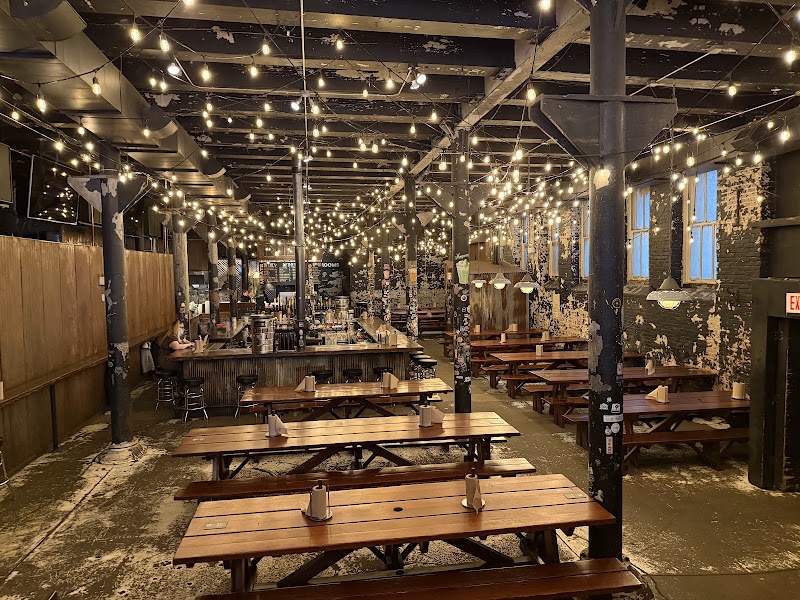
The room is industrial in the way this district genuinely is rather than in the way cafés usually pretend to be: a former meatpacking block, raw wood, hard surfaces, and a wall of windows that throws a lot of daylight across the floor. Seating is deliberately communal — long benches and picnic-style tables — which means the room seats a crowd and mixes strangers rather than parceling out private zones.
The decoration is where Sawada’s own taste shows. Skateboard decks line the walls, a streetwear-branded punching bag hangs in the room, and there is a table-tennis table that is not a prop. It is a Tokyo street-culture aesthetic dropped into a Chicago warehouse district, and it lands better than that description suggests, because both halves are authentic to their place. Nothing here is antique, curated or nostalgic; it is a young, loud, slightly athletic room.
The honest weaknesses are the same as the strengths. Communal benches mean you may share a table. Hard surfaces mean the sound builds fast when the room fills. And there is often a line — the counter moves quickly, but at peak weekend hours you will wait.
Beyond coffee
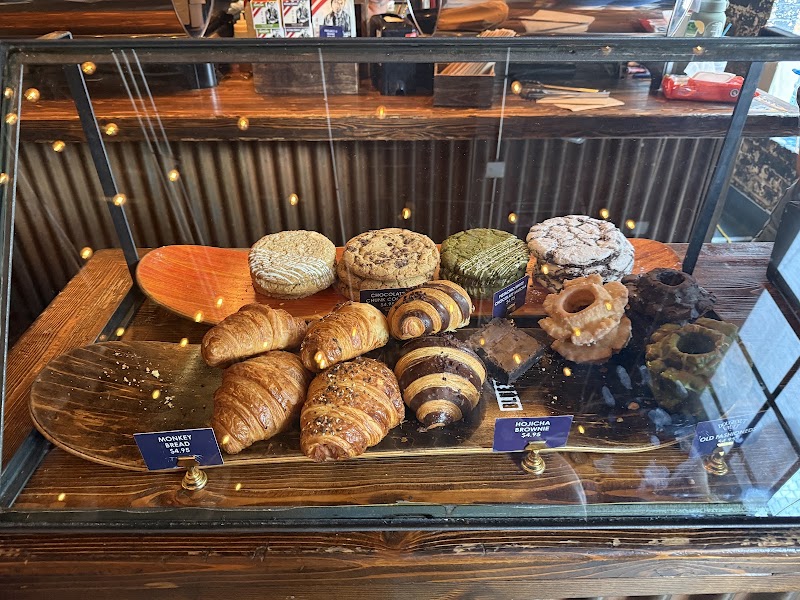
Food is deliberately narrow: a pastry counter and the doughnuts made by the group’s own doughnut brand, including a camouflage doughnut built to match the signature latte. That is the whole story, and it is honest — this is a coffee bar with something to eat, not a breakfast restaurant. Nobody here is trying to sell you brunch.
What fills the gap is the wall. The smokehouse sharing the premises serves a full barbecue menu, and the two businesses are connected inside, so a proper meal is one doorway away. In practice many visits work in that order: eat there, drink here.
When to come
This is a daytime café, seven days a week, opening in the morning and closing in the afternoon — there is no evening trade at all, so an after-work coffee here is not a plan. The calmest and best window is the first stretch after opening on a weekday: no line, a quiet counter, and the best chance of watching the pouring up close and asking a question about it.
Weekends are a different animal. The Fulton Market district fills with people doing the restaurant-and-gallery circuit, the café becomes a destination rather than a neighborhood stop, and the line outside is at its longest around the middle of the day. If you specifically want the Military Latte photograph without the wait, come early. Current opening times are in the schedule block on this page.
Getting there
You are in the Fulton Market district on the western edge of downtown, the old meatpacking quarter that has become Chicago’s densest concentration of restaurants and tech offices. The nearest “L” is Morgan on the Green and Pink lines, a couple of minutes’ walk — one of the easiest transit approaches of any café on this list. Ogilvie and Union Station are both a short walk east if you are arriving by commuter rail. Driving is the weakest option: street parking in this district is scarce and slow, and the neighborhood is built for walking. From the Loop it is a twenty-minute stroll west across the river.
Good to know
Three practical notes. First, order the Military Latte on your first visit even if matcha is not usually your thing — it is the reason the café exists, and a plain latte, however beautifully poured, is not the same experience. Second, do not come here planning to work all afternoon; the seating is communal, the outlets are few and the doors close well before evening. Third, if the line is out the door, check whether it is a takeaway queue before you give up — a lot of it is.
One piece of context that explains the place’s standing: when it opened, the idea that a Japanese latte art champion would choose Chicago for his first café outside Tokyo was genuinely surprising, and the city took it as a compliment. The blend developed with a local roaster rather than imported from Japan was the part that convinced the coffee community it was serious. Years later, the café is still the most direct line between the Tokyo and Chicago coffee scenes that either city has.
Questions and answers
What is the Military Latte?
The house signature: matcha and vanilla layered with espresso and milk, finished with cocoa dusted through a stencil into a camouflage pattern. It was invented at this café and has been copied internationally since. Grassy and bitter from the matcha, sweet and chocolatey from the finish.
Do they roast their own coffee?
No — and the reason is interesting. The house blend, Project X, was developed specifically for this café with a Chicago roaster, rebuilding the taste of Sawada’s Tokyo roast on beans that can be delivered fresh. It is bought in, but it exists only because of this café.
Is the latte art really that good?
Yes. The founder is a free-pour latte art world champion, and competition-standard pouring is the house norm rather than a special occasion. It is worth standing where you can see the bar.
Can I work here with a laptop?
For an hour on a quiet weekday, yes. For a working day, no — seating is mostly communal benches, power outlets are scarce, the counter is noisy, and the café closes in the afternoon.
Is there food?
Only pastries and doughnuts, including a camouflage doughnut matched to the signature latte. For a real meal, the barbecue smokehouse sharing the premises is directly connected inside.
Is there oat milk and decaf?
Yes to both, alongside the standard dairy options.
Will I have to queue?
Often, at weekends and around the middle of the day. It moves faster than it looks because a large share of the line is taking coffee away rather than waiting for a seat.
Is it open in the evening?
No. It runs a daytime schedule seven days a week and closes in the afternoon.
Is there really a ping-pong table?
There is, and a punching bag, and skateboard decks on the walls. The room is an import of Tokyo street culture into a Chicago warehouse district, and none of it is decorative-only.
Opening hours
| Day | Hours |
|---|---|
| Monday | 08:00–16:00 |
| Tuesday | 08:00–16:00 |
| Wednesday | 08:00–16:00 |
| Thursday | 08:00–16:00 |
| Friday | 08:00–16:00 |
| Saturday | 08:00–16:00 |
| Sunday | 08:00–16:00 |
Photos
Visitor reviews
Reviews last updated: 2026-08-10 15:36:38
Data is refreshed monthly. Sources: chicagoka.com and editorial picks based on reviews.
Кав'ярня «Савада» не схожа на звичайне кафе, це радше творчий куточок з кофеїновою ноткою. Простір має індустріальний стиль з енергетикою тату-салону, але водночас створює відчуття тепла та затишку.
Їхній фірмовий війсь…
I had an amazing experience here, easy 5 star spot for me.
The drinks were on another level, super well-crafted, balanced, and clearly made with a lot of attention to detail. I ordered the military latte, black camo lat…
Неймовірна атмосфера та напої найвищого ґатунку!
У середу вранці ми завітали до кав'ярні Sawada Coffee у районі Фултон Маркет, і це місце вже було жвавим та вирувало енергією. Сільський, індустріальний інтер'єр з унікал…
Ми відвідуємо Чикаго та чули про цю кав'ярню. Район розташований одразу за межами центру міста, що робить його дуже жвавим районом. Навколишня місцевість дуже модна, з багатьма новими будівлями, переважно житловими, з де…
Гарна, еклектична кав'ярня з чудовою атмосферою та обслуговуванням. Якість кави була пристойною, але не вражаючою. Я сноб щодо високоякісної звичайної кави, але моїй родині, яка любить креативні кавові моктейлі, дуже спо…